Visibility Insights
Practical marketing, Google visibility, event strategy, customer experience, and sales insights to help you get found, build trust, and generate more revenue.
Marketing trends come and go.
Strong visibility, meaningful customer relationships, and sustainable revenue never go out of style.
At ElluminateHER, we believe visibility should create trust, trust should create conversations, and conversations should create customers.
That's why every article we publish is designed to help service-based businesses increase their visibility, strengthen customer trust, and generate more revenue.
Whether you're improving your Google presence, marketing an event, creating a better customer experience, or refining your sales strategy, you'll find practical frameworks, proven strategies, and actionable insights you can put to work immediately.
Because visibility isn't the goal. Revenue is.
Featured Insight
This is where you'll find our latest in-depth strategy, framework, or guide designed to help you grow your business with greater clarity and confidence.
Latest Insights
Explore our newest articles covering:
Google Visibility
Marketing Strategy
Event Marketing
Event Revenue
Customer Experience
Sales
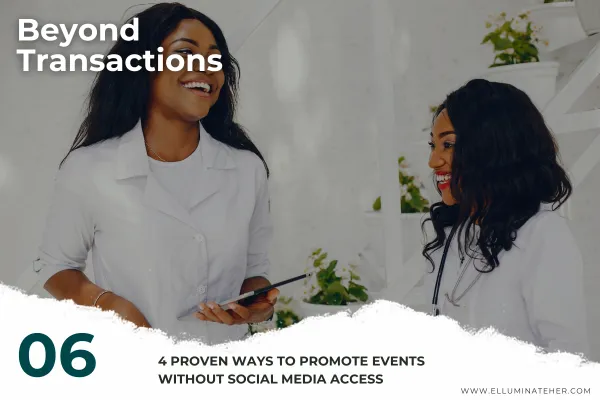
How to Promote an Event Without Social Media: 4 Proven Strategies
How to Promote an Event Without Social Media: 4 Proven Strategies
Quick Answer: You can promote an event without social media by using email marketing, strategic partnerships, offline community outreach, and personal invitations. The strongest event campaigns use multiple visibility channels so registration does not depend entirely on one platform, one algorithm, or one audience.
What Would Happen If Instagram Disappeared Tomorrow?
Imagine waking up one morning and realizing you no longer have access to Facebook or Instagram.
No Stories.
No event posts.
No DMs.
No Reels.
No direct access to the audience you've spent years building.
And your event is only a few months away.
What do you do?
I had a client experience almost exactly this.
They were preparing for an event when they lost access to the social media platforms they had expected to use for promotion.
And yes, it was stressful.
But it also forced us to answer a question I think every event host should ask:
If social media disappeared tomorrow, how would people find out about your event?
Because if your answer is:
"Honestly...they wouldn't."
that's not just a social media problem.
That's a visibility problem.
Social media is an incredible marketing tool.
I use it.
I believe in it.
But it should be one road leading people to your event, not the only road.
Losing access to a platform shouldn't mean losing access to your entire audience.
And even if you never lose your account, algorithms change.
Reach drops.
People don't see every post.
Your followers aren't always your ideal attendees.
Sometimes the people who most need to know about your event aren't following you at all.
That's why event marketing needs a broader strategy.
Your Event Needs More Than a Social Media Plan
I think we've gotten so accustomed to digital marketing that our event promotion checklist sometimes looks like this:
Create flyer.
Post flyer.
Post Reel.
Share to Stories.
Ask speakers to repost.
Post flyer again.
😂
Then two weeks before the event:
"Why aren't tickets moving?"
Because marketing an event requires more than repeatedly showing the same message to the same audience.
You need to think about:
Where your ideal attendees already spend time.
Who already has relationships with them.
What organizations they're connected to.
Which email lists they're on.
What businesses they visit.
What communities they belong to.
Who they trust.
How they make decisions.
The goal isn't to be everywhere.
The goal is to create enough relevant pathways for the right people to discover your event.
At ElluminateHER, I like to think of this as creating multiple roads to the same destination.
Social media is one road.
Email is another.
Partnerships are another.
Personal invitations are another.
Community outreach is another.
Event calendars are another.
Word of mouth is another.
Different roads. Same destination.
And in this case, the destination is the registration page.
Here are four places I would start.
1. Use Your Email List Like an Actual Relationship
Email is one of the first places I would turn if social media suddenly became unavailable.
And I don't care if your list is small.
A smaller list of people who know you can be far more valuable than a massive audience that barely pays attention.
The mistake is sending:
Subject: REGISTER NOW!!!
followed by the flyer.
Then another flyer.
Then:
Last chance!!!
That's not much of an email strategy.
Your emails should help someone understand:
Why this event exists.
Who it's for.
Why it matters.
What they're going to experience.
What problem it solves.
Who they'll meet.
Why they should prioritize being there.
Tell the Story Behind the Event
Why did you create it?
What made you realize this room needed to exist?
What do you want people to walk away with?
Why now?
People connect with meaning.
They don't only need logistics.
Give Them a Look Behind the Scenes
Introduce speakers.
Share planning moments.
Talk about the conversations you hope will happen.
Show what you're building.
Let people feel like they're watching the experience come together.
Anticipation matters.
Answer the Questions That Prevent Registration
People may be wondering:
Is this for someone like me?
Can I come alone?
What should I wear?
Will I actually meet people?
Is it worth the ticket price?
What happens during the event?
Answer those questions before they become reasons not to register.
Ask People to Reply
This is one of my favorite things about email.
It can become a conversation.
Ask:
"What would make this event valuable for you?"
Or:
"Are you thinking about attending but have a question?"
Or:
"Who would you love to meet in the room?"
Now your email isn't just broadcasting.
You're learning.
And some of those replies may become real conversations that help someone decide whether the event is right for them.
That's one of the things I want business owners to remember:
Event marketing should create conversations, not just impressions.
2. Build Strategic Partnerships With People Who Already Have Your Audience
This might be one of the most underused event marketing strategies.
You don't have to personally know every person who might attend your event.
You can build relationships with people and organizations who already know them.
Ask:
Who already has the audience I want in the room?
That could include:
Professional organizations.
Community groups.
Local businesses.
Associations.
Coworking spaces.
Churches.
Schools.
Speakers.
Sponsors.
Media outlets.
Networking groups.
Nonprofits.
Industry organizations.
Influencers or content creators.
Complementary service providers.
Now instead of trying to reach every potential attendee one person at a time, you're tapping into existing communities.
But Don't Lead With "Can You Promote My Event?"
Please.
😂
Partnerships should make sense for both sides.
Explain:
Why their audience would care.
How the event aligns with their mission.
What value you're offering.
How you'll support them.
What the collaboration could look like.
Maybe they're featured as a community partner.
Maybe you promote their organization to attendees.
Maybe there's an affiliate commission.
Maybe they receive complimentary tickets.
Maybe they have an opportunity to participate.
Maybe the alignment itself is enough.
The important thing is that it feels like a partnership, not:
"Hey, can you post my flyer?"
Make Promotion Easy
Once a partner says yes, don't make them work.
Provide:
The event description.
Registration link.
Graphics.
Suggested email copy.
Social copy if applicable.
Key dates.
Audience description.
Any tracking or affiliate link.
The easier you make it, the more likely the promotion actually happens.
A strong 90-Day Marketing Experience gives you time to identify and activate these relationships before you're in panic mode trying to fill the last 37 seats.
Because partnerships need runway.
3. Go Where Your Audience Already Is
This is where offline marketing starts getting fun.
Ask yourself:
Where do my ideal attendees physically spend time?
If you're hosting a local women's business event, they may be in:
Coworking spaces.
Coffee shops.
Salons.
Boutiques.
Fitness studios.
Community centers.
Professional organizations.
College campuses.
Chamber events.
Networking mixers.
Business centers.
Libraries.
Churches.
Local conferences.
Your strategy might include:
Flyers.
Postcards.
Printed invitations.
Community boards.
Event calendars.
Table cards.
Partner locations.
Local event listings.
Speaking appearances.
In-person networking.
Direct outreach to organizations.
And yes, physical marketing materials still work.
We've gotten so used to everything being digital that sometimes a beautifully designed invitation sitting in someone's hand actually stands out because it isn't another post.
Don't Just Drop Flyers Everywhere
Be strategic.
A stack of flyers in a location where none of your ideal attendees visit isn't marketing.
It's paper storage. 😂
Think about audience alignment.
If your event is for local wellness professionals, where are they already gathering?
If it's for women executives, what professional organizations are they part of?
If it's for parents, what local businesses serve families?
If it's for entrepreneurs, what business centers or networking communities already exist?
Go where the people already are.
That principle works online and offline.
4. Personally Invite People
I will probably never stop talking about personal invitations.
Because they work.
There is a huge difference between seeing a flyer and receiving:
"I thought about you."
Imagine opening a message that says:
"Hey Jessica, I'm hosting a workshop next month for women business owners who are trying to become more visible locally. We've talked before about how difficult it has been to reach new customers, and I genuinely think you'd get a lot out of this room. I'd love to have you there."
Now compare that with:
"Tickets on sale now! Link in bio!"
Completely different experience.
Personal invitations create context.
They make the person understand:
Why me?
Why this?
Why now?
And I think business owners sometimes avoid them because they feel too much like sales.
But inviting the right person to an experience that could genuinely benefit them isn't something to feel weird about.
You're giving them an opportunity to decide.
Personal Doesn't Mean Manipulative
Don't guilt people.
Don't say:
"I supported your event, so you should support mine."
Don't send a generic copy-and-paste message and pretend it's personal.
And don't make someone's no awkward.
Personal invitations work best when they're:
Specific.
Relevant.
Warm.
Honest.
And easy to decline.
You want:
"I immediately thought of you because..."
Not:
"Hey babe! I have 11 seats left."
😂
Start With the Warmest People
Look at:
Past attendees.
Current clients.
Former clients.
Referral partners.
Professional relationships.
People who have previously expressed interest.
People you've met at networking events.
Community connections.
People on your email list who consistently engage.
Then expand outward.
The goal isn't to message your entire phone.
The goal is to identify people who actually make sense for the room.
Why These Four Strategies Work Together
The magic isn't picking one.
It's combining them.
Someone receives an email.
Then they see a flyer at their coworking space.
Then a friend says:
"Are you going to this?"
Then you personally invite them.
Now the event feels familiar.
That's what repeated visibility can do.
Different channels reinforce one another.
Maybe email introduces the event.
A partnership builds credibility.
A personal invite gives someone the final reason to register.
Offline visibility reminds them.
That's why diversified event marketing is so much stronger than:
Post and hope.
You're creating multiple opportunities for the right person to encounter the same experience.
And sometimes people need more than one exposure before they're ready to act.
Don't Wait Until Social Media Stops Working to Diversify
This is probably the biggest lesson from the client situation I mentioned earlier.
We had to diversify because we were forced to.
You don't have to wait for that.
You can build the diversified strategy before something goes wrong.
Ask yourself today:
If Instagram disappeared...
Could I email my audience?
Do I have relationships with local organizations?
Do I know where my customers gather?
Do I have past attendees I can contact?
Do I have partnerships?
Do people know how to refer others to the event?
Is my event listed anywhere besides social media?
Can I reach people directly?
If the answer is no across most of those, start building now.
Because your visibility should never be held hostage by one platform.
Social Media Is Still Useful—It's Just Not the Whole Strategy
I want to be clear.
This isn't:
"Stop using social media."
Social media can be fantastic for event marketing.
Use the Reels.
Post behind the scenes.
Share the speakers.
Create the graphics.
Go Live.
Let attendees share.
Use paid social when appropriate.
All of it.
Just don't confuse:
"We posted about the event."
with:
"We marketed the event."
Those aren't necessarily the same thing.
Social media is one piece of a broader visibility ecosystem.
And I want your event to be discoverable through enough different paths that one algorithm can't determine whether your room is full.
Event Promotion Should Start Earlier Than You Think
A lot of event hosts don't actually have a visibility problem.
They have a timing problem.
They launch too late.
Now everything is urgent.
They don't have enough time to:
Build partnerships.
Get approved for event calendars.
Create community relationships.
Send a meaningful email sequence.
Personally invite people without feeling frantic.
Follow up.
Test messages.
Reach new audiences.
Let word of mouth build.
Suddenly every strategy becomes:
"Can you post this today?"
That's difficult.
This is why our event marketing work is built around a 90-Day Marketing Experience.
It's not because every event requires exactly 90 days.
It's because strategic promotion benefits from enough runway to reach beyond the audience you already have.
You need time to build momentum.
Not just urgency.
Don't Measure Your Event Marketing Only by Reach
Here's another mistake.
You promote the event.
A post gets 12,000 views.
Great.
Then what?
Did anyone register?
An organization shared the flyer with 5,000 members.
Wonderful.
How many clicked?
You sent 600 emails.
How many people became interested?
You personally invited 30 people.
How many responded?
This is where I always come back to one question:
What happened next?
Because:
Attention is not the same thing as opportunity.
Event marketing should create movement.
That might mean:
Registrations.
Replies.
Website visits.
Questions.
Partner introductions.
Email signups.
Calls.
Conversations.
Referrals.
You don't need every marketing activity to generate an immediate ticket sale.
But you should understand which activities are creating movement and which ones are simply creating activity.
A Quick Event Visibility Audit
Before you publish another event post, answer these questions:
Do I have an email list I can use to communicate directly with interested people?
Partnerships
Which organizations or businesses already have relationships with my ideal attendees?
Offline Visibility
Where does my audience physically gather?
Personal Invitations
Who are the first 25–50 people I would genuinely love to have in the room?
Event Listings
Where else can someone discover the event besides my own channels?
Referral Strategy
Have I made it easy for supporters, speakers, partners, and attendees to tell other people?
Timing
Do I have enough runway to use these strategies properly?
Tracking
Do I know which channels are actually generating registrations?
If your entire campaign is:
Instagram + Facebook + hope
you've identified the gap.
Filling the Room Is Only the First Job
There's one more distinction I want event hosts to understand.
Event marketing gets people into the room.
But if your event is connected to a business objective, you also need to know what you want to happen after they arrive.
Maybe attendees:
Join your list.
Schedule a consultation.
Become members.
Purchase a service.
Apply for a program.
Attend another event.
Become referral partners.
Buy an offer.
Your event doesn't need to become a giant sales pitch.
But attendance should lead somewhere if business growth is one of the goals.
That's where event marketing and Event Revenue Partner work become two different functions.
The marketing strategy helps the right people discover and attend the event.
The revenue strategy focuses on what happens before, during, and after the event to create meaningful sales opportunities through Align→ Court→ Convert → Continue.
Because a full room creates opportunity.
What happens next determines what that opportunity becomes.
Want More Ways to Promote Your Event Beyond Social Media?
If you're ready to stop relying entirely on Instagram and Facebook to fill your event, start with the Reach Your Audience Guide.
It includes 15 offline strategies you can use to expand your event visibility, reach new audiences, and create more pathways for the right attendees to discover your event.
Download the Reach Your Audience Guide →
And if you have an event on the calendar and need a more comprehensive strategy for reaching the right audience, our 90-Day Marketing Experience helps build the campaign behind your event.
Continue Building Your Event Strategy
How to Fill Your Event Through Relationships: The Power of Reciprocity
Learn how relationship marketing, personal invitations, partnerships, and community connections can expand your reach beyond your existing audience.
Virtual vs. In-Person Events: Which Is Better for Your Business?
Choosing your event format? Compare how virtual and in-person events support different audience, visibility, engagement, and business goals.
Event Offer Alignment Guide
If your event is connected to an offer, make sure what you're selling naturally aligns with the audience and experience you've created.
The Visibility Letter
Get weekly strategies for visibility, event marketing, customer experience, Google, sales, and turning attention into business growth.
Frequently Asked Questions About Promoting an Event Without Social Media
Can you successfully promote an event without social media?
Yes. Events can be promoted through email marketing, personal invitations, strategic partnerships, community outreach, event calendars, local organizations, printed materials, referrals, speakers, word of mouth, and other channels. Social media can support the campaign but does not need to be the only source of visibility.
How do I promote a local event without Facebook or Instagram?
Start with local email lists, community organizations, businesses that serve your audience, chambers and professional groups, physical flyers and invitations, community calendars, local media, referral partners, and direct outreach to people who are likely to attend.
What is the best offline way to promote an event?
There isn't one best strategy for every event. The strongest option depends on your audience. Personal invitations can work especially well for relationship-driven events, while community partnerships and local organizations can be powerful when they already have access to your ideal attendees.
How can I use email to promote an event?
Use email to explain why the event matters, introduce speakers, answer common questions, share behind-the-scenes information, highlight outcomes, create urgency when appropriate, and invite recipients to reply with questions. A sequence generally creates more opportunities for engagement than sending one registration announcement.
How can partnerships help increase event attendance?
Partners can introduce your event to audiences that already know and trust them. Strong partnerships work best when the event is genuinely relevant to the partner's community and there is a clear mutual benefit.
Are flyers still effective for event marketing?
They can be, particularly for local events when they're distributed strategically in places your ideal attendees already visit. Flyers work best as one part of a broader campaign rather than the only promotional method.
Do personal invitations really increase event attendance?
Personal invitations can be effective because they create context and help the recipient understand why the event is relevant to them specifically. They work best when they're genuine and targeted rather than sent as mass copy-and-paste messages.
How early should I start promoting an event?
The right timeline depends on the size, price, location, audience, and commitment required. Starting earlier generally gives you more time to develop partnerships, secure event listings, nurture your email audience, send personal invitations, follow up, and build repeated visibility before event day.
Ready for Personalized Guidance?
Every business is different.
If you're looking for a strategy tailored specifically to your business, schedule a Visibility Strategy Call.
Together, we'll identify opportunities to increase your visibility, build customer trust, and create a clear plan for sustainable business growth.