
Why Great Customer Experience Is One of Your Best Sales Strategies
Why Great Customer Experience Is One of Your Best Sales Strategies
Quick Answer: A strong customer experience can directly influence sales by increasing trust, reducing hesitation, making it easier to buy, generating positive reviews and referrals, and giving customers reasons to return. For service businesses especially, every interaction—from the first Google search to follow-up after the sale—shapes whether someone chooses you and recommends you to someone else.
The Sale Starts Earlier Than You Think
When we think about sales, most of us picture the moment someone is actually being asked to buy.
The consultation.
The discovery call.
The proposal.
The checkout page.
The offer at the end of an event.
But I think the sale starts much earlier than that.
It starts when someone searches for you.
When they read your reviews.
When they click on your website.
When they send an inquiry.
When someone answers the phone.
When they walk into your business.
When they're greeted.
When they ask a question.
When you explain what happens next.
Every one of those moments is shaping the customer's decision.
They're quietly asking themselves:
Do I trust these people?
Do they know what they're doing?
Do I feel comfortable here?
Is this worth my money?
Do I want to keep going?
That's customer experience.
And that is why I believe customer experience is one of the most overlooked sales strategies in business.
You can have the best sales script in the world, but if everything leading up to the sales conversation makes the customer feel uncertain, ignored, confused, or undervalued, you've made selling much harder than it needed to be.
On the other hand, when someone has a great experience from the beginning, you don't have to work nearly as hard to convince them.
The experience has already started selling for you.
Customer Experience Isn't Just What Happens After Someone Buys
I think this is where businesses sometimes get customer experience wrong.
They think customer experience starts after the transaction.
Send the thank-you email.
Provide great service.
Ask for a review.
Done.
But the customer experience begins long before payment.
Think about the full journey.
Someone finds your business on Google.
They see recent photos.
Your hours are correct.
Your reviews are strong.
Your website is easy to understand.
They click to contact you.
Someone responds quickly.
The process for booking is simple.
They know what to expect.
They walk in and are greeted warmly.
The consultation feels informative instead of pushy.
Pricing is clear.
The next step makes sense.
At every stage, you're either increasing confidence or introducing friction.
And customers feel that.
Even if they can't articulate exactly why they chose one business over another.
Sometimes the deciding factor isn't:
"They had the cheapest price."
It's:
"Everything just felt easier."
That matters.
Your Customer Experience Is Making a Promise About Your Business
Your marketing tells people what to expect.
Your customer experience tells them whether you meant it.
If your website says:
Personalized service.
But the customer feels like another number?
Disconnect.
If your brand says:
Luxury experience.
But the booking process is chaotic?
Disconnect.
If you say:
We put our customers first.
But no one responds for three days?
Disconnect.
If you advertise:
Stress-free process.
But the customer has to chase you for updates?
Disconnect.
This is why customer experience and marketing can't be treated like completely separate departments.
The marketing makes a promise.
The experience either proves it or breaks it.
And once customers start experiencing a disconnect between what you said and what you delivered, trust starts disappearing.
That's when sales become harder.
Reviews become weaker.
Referrals decrease.
Repeat business becomes less likely.
1. Great Customer Experience Builds Trust Before the Sale
Trust is one of the biggest factors in service-based buying decisions.
Because customers aren't just buying an object.
They're trusting someone to perform a service.
They may be trusting you with their body.
Their home.
Their finances.
Their business.
Their wedding.
Their event.
Their reputation.
Their future results.
That's a much bigger decision.
So anything you can do to reduce uncertainty helps.
Clear communication helps.
Professionalism helps.
Proof helps.
Consistency helps.
Reviews help.
A smooth process helps.
Being responsive helps.
And when all of those things work together, the customer starts feeling:
"Okay. I'm in the right place."
I've watched this happen firsthand.
Working in the aesthetics industry, I've seen how a strong reputation changes a sales conversation.
As our studio grew to more than 850 Google reviews, customers increasingly came into consultations already confident.
They had researched us.
They had read what other people said.
They had seen the results.
The trust-building had already begun before I ever sat down with them.
That's why I believe a consistent system to build trust with more five-star reviews is so valuable for service businesses. Reviews aren't simply something nice to display after a successful transaction. They're part of the experience of your future customers, too.
Your existing customers are helping your next customer decide.
That's powerful.
2. Great Customer Experience Makes Buying Easier
I don't think we talk enough about ease as a sales strategy.
Sometimes businesses unintentionally make customers work entirely too hard to give them money.
You have to send three emails to get pricing.
The booking link doesn't work.
No one answers the phone.
The website doesn't explain the next step.
The customer submits a form and hears nothing.
They have to call back.
Then call again.
Then somehow we're shocked when they disappear.
They didn't necessarily decide they didn't want the service.
They may have simply decided:
"This is too much."
Customers have enough friction in their lives already.
Don't create more of it unnecessarily.
Ask yourself:
How easy is it to understand what we sell?
How easy is it to contact us?
How quickly do we respond?
How easy is it to schedule?
How clear is pricing?
How easy is payment?
Do customers know what happens after they buy?
Can they easily get answers?
Every unnecessary obstacle gives someone another opportunity to change their mind.
Great customer experience removes those obstacles.
And removing friction can increase sales without generating a single additional lead.
3. Great Customer Experience Improves the Sales Conversation
There's a huge difference between selling to someone who's skeptical and selling to someone who already feels taken care of.
If the customer has had a confusing experience before they meet you, part of your sales conversation now has to repair that uncertainty.
If they've been waiting days for responses, they're already evaluating whether communication will be a problem later.
If pricing changed three times, they're wondering what else will change.
If no one seems organized, they're wondering whether their service will be organized.
Now imagine the opposite.
Communication has been clear.
Someone answered their questions.
The process has been easy.
They know what to expect.
They already feel respected.
By the time you talk about the offer, the customer isn't spending half of the conversation deciding whether your business is competent.
That part has already been demonstrated.
The sales conversation can focus on:
Their needs.
Their questions.
The solution.
The investment.
The next step.
That's why I don't see customer experience as separate from sales.
Customer experience creates the conditions that make good sales conversations possible.
4. Great Customer Experience Gives Customers Something to Talk About
People talk about businesses that make them feel something.
Good or bad. 😂
Think about your own conversations.
You don't always tell your friends:
"The technical execution of this service aligned with industry standards."
You say:
"Girl, they took SUCH good care of me."
Or:
"Don't go there. They never called me back."
That is customer experience becoming word-of-mouth marketing.
Every experience creates a story.
The question is:
What story are your customers telling?
A memorable experience gives people something specific to share.
Maybe your team remembered their name.
Maybe you solved a problem quickly.
Maybe you followed up when they weren't expecting it.
Maybe the consultation was incredibly educational.
Maybe they felt genuinely listened to.
Maybe your event made them feel welcomed instead of awkward.
Maybe something went wrong and you handled it so well that they trusted you even more afterward.
Those stories matter.
Because recommendations are more persuasive when they're specific.
"They're great" is fine.
But:
"Ask for Sarah. She explained everything, never pressured me, followed up afterward, and made the entire process easy."
That's a sales asset.
And your customer created it for you.
5. Great Customer Experience Creates Better Reviews
This is where the relationship between customer experience, visibility, and revenue becomes really interesting.
A customer has a great experience.
They leave a review.
That review helps another potential customer trust you.
That customer chooses you.
They have a great experience.
They leave another review.
And the cycle continues.
This is why reviews are more than reputation management.
They're part of a growth engine.
Your customer experience today affects your visibility tomorrow.
And there's a big difference between hoping customers will review you and having a consistent process for asking.
Customers are busy.
They can love you and still forget.
They can tell you:
"I'm definitely going to leave a review!"
And then life happens.
That's normal.
The responsibility is on the business to make the request clear and easy.
If you have happy customers but your Google profile doesn't reflect it, our free guide Why Customers Aren't Leaving Google Reviews walks through some of the most common reasons—and what to do about them.
The goal isn't to pressure customers for praise.
It's to make it easy for people who genuinely had a great experience to share it.
6. Great Customer Experience Creates Referrals
A great experience doesn't always create another transaction immediately.
Sometimes it creates an introduction.
And that can be just as valuable.
When someone has confidence in your business, recommending you becomes easier.
They're putting their own reputation on the line when they refer someone.
Think about that.
If I recommend a photographer to my friend and the photographer is terrible, that reflects on me a little bit.
If I recommend a consultant to someone in my network and they have an incredible experience?
Now I look helpful.
People refer businesses when they feel confident that the person they're sending will be taken care of.
That confidence comes from experience.
So when you're thinking about referral strategy, don't only ask:
"How can we get customers to refer more people?"
Also ask:
"Are we creating an experience worth attaching their name to?"
That's a much deeper question.
7. Great Customer Experience Creates Repeat Customers
Sometimes we're so focused on acquiring new customers that we forget there are people who already know us.
They've already trusted us.
They've already purchased.
They've already experienced the service.
And if that experience was great, the second sale can be much easier than the first.
Depending on your business, repeat revenue could come from:
Ongoing services.
Maintenance.
Additional treatments.
Retainers.
Renewals.
Upgrades.
New programs.
Related offers.
Future events.
Seasonal purchases.
Customer retention matters because acquiring attention over and over is expensive.
You don't want to have to start every sales relationship from zero.
Great customer experience gives people a reason to stay in your ecosystem.
And even when your service isn't something customers purchase frequently, a strong experience can keep you top of mind when a referral opportunity appears.
You want the customer thinking:
"I know exactly who you need to call."
That's valuable.
8. Customer Experience Can Become Your Competitive Edge
This is one of my favorite things about customer experience.
Competitors can copy a lot.
They can copy your pricing.
Your package.
Your promotional offer.
Your website structure.
Your event idea.
Your content topic.
Your product features.
But consistently creating a particular feeling is harder to copy.
That requires culture.
Training.
Standards.
Intentionality.
Leadership.
And repetition.
This is why some businesses become known for how they treat people.
Not just what they sell.
For service businesses especially, that can become an enormous competitive advantage.
Someone may have five options that technically solve the same problem.
But if one business has hundreds of reviews describing how comfortable, cared for, understood, or supported people felt?
That's differentiation.
Your customer experience can become part of why you're easier to choose.
Small Details Matter More Than You Think
I think sometimes business owners assume customer experience has to mean expensive gifts, elaborate packaging, or over-the-top hospitality.
It doesn't.
It can.
But some of the most meaningful things cost almost nothing.
Remember someone's name.
Respond when you said you would.
Tell them what happens next.
Follow up.
Be on time.
Communicate delays.
Listen.
Explain things clearly.
Make pricing easy to understand.
Thank them.
Fix the problem when something goes wrong.
Notice something personal.
Check in afterward.
Those are small moments.
But customers experience businesses through moments.
That's why little things become big things.
I learned this with events too.
I've given red roses to attendees.
I've written personalized letters.
Those things aren't required to host a successful event.
But they're part of the experience I want someone to remember.
You're communicating:
"I thought about you being here."
That's the kind of detail people remember long after they've forgotten the agenda.
Customer Experience Doesn't Mean Saying Yes to Everything
I do want to make this distinction because good customer service sometimes gets confused with being endlessly accommodating.
That's not what I'm talking about.
A strong customer experience still needs boundaries.
Policies.
Expectations.
Professionalism.
You can say no.
You can enforce cancellation policies.
You can protect your time.
You can decide someone isn't a good fit.
You can refuse unreasonable requests.
In fact, clarity can improve the customer experience.
Customers don't need a business that says yes to everything.
They need a business that communicates clearly and consistently.
Sometimes the best experience is simply knowing exactly what to expect.
What Happens When Something Goes Wrong Matters Too
No business creates a perfect customer experience 100% of the time.
Something will go wrong.
A delay.
A mistake.
A technical issue.
A scheduling problem.
A miscommunication.
A customer who isn't happy.
The goal isn't perfection.
The goal is how you respond.
A problem can damage trust.
But the way you handle that problem can also build trust.
Do you become defensive?
Ignore the customer?
Blame someone else?
Disappear?
Or do you listen?
Acknowledge what happened?
Communicate clearly?
Find a reasonable solution?
Follow through?
Customers pay attention to how businesses behave when everything isn't perfect.
Sometimes recovery becomes one of the strongest parts of the experience.
Because now the customer knows:
"If something goes wrong, they're going to take care of me."
That's trust.
Stop Treating Customer Experience Like an Afterthought
Customer experience shouldn't be something you think about after your marketing is done.
It should influence the marketing.
The sales process.
The offer.
The team.
The follow-up.
The review strategy.
The event experience.
The retention strategy.
Because if marketing gets someone through the door and the experience pushes them back out, you don't have a marketing problem.
You have a customer journey problem.
And that can become expensive very quickly.
You can keep paying for:
More ads.
More leads.
More events.
More social media.
More traffic.
More promotions.
But if the experience doesn't give customers a reason to trust you, buy, return, review, and refer?
You're continually paying to replace people you could have kept.
A Simple Customer Experience Audit
I want you to walk through your business as though you're a brand-new customer.
Not as the owner.
Not as the person who already knows how everything works.
As someone who has never interacted with the business before.
Discovery
Can I easily find accurate information about the business?
First Impression
Does what I find make me feel confident?
Inquiry
Is it easy to contact someone?
Response
How long do I wait, and how does the response make me feel?
Buying Process
Is it obvious what I should do next?
Communication
Do I know what to expect before receiving the service?
Experience
Does the actual service match what the marketing promised?
Follow-Up
Does the relationship disappear the moment I pay?
Review
Do you make it easy for me to share a positive experience?
Return
Do you give me a reason to come back or remain connected?
You may find areas that are excellent.
Great.
Protect those.
You may also discover little points of friction you stopped noticing because you've seen the process 500 times.
Fix those.
Sometimes one small improvement can completely change the way customers experience your business.
Great Customer Experience Creates a Sales Flywheel
This is how I want you to think about the relationship between customer experience and revenue:
Great Experience → Trust → Sale → Review → Referral → Repeat Business → More Trust
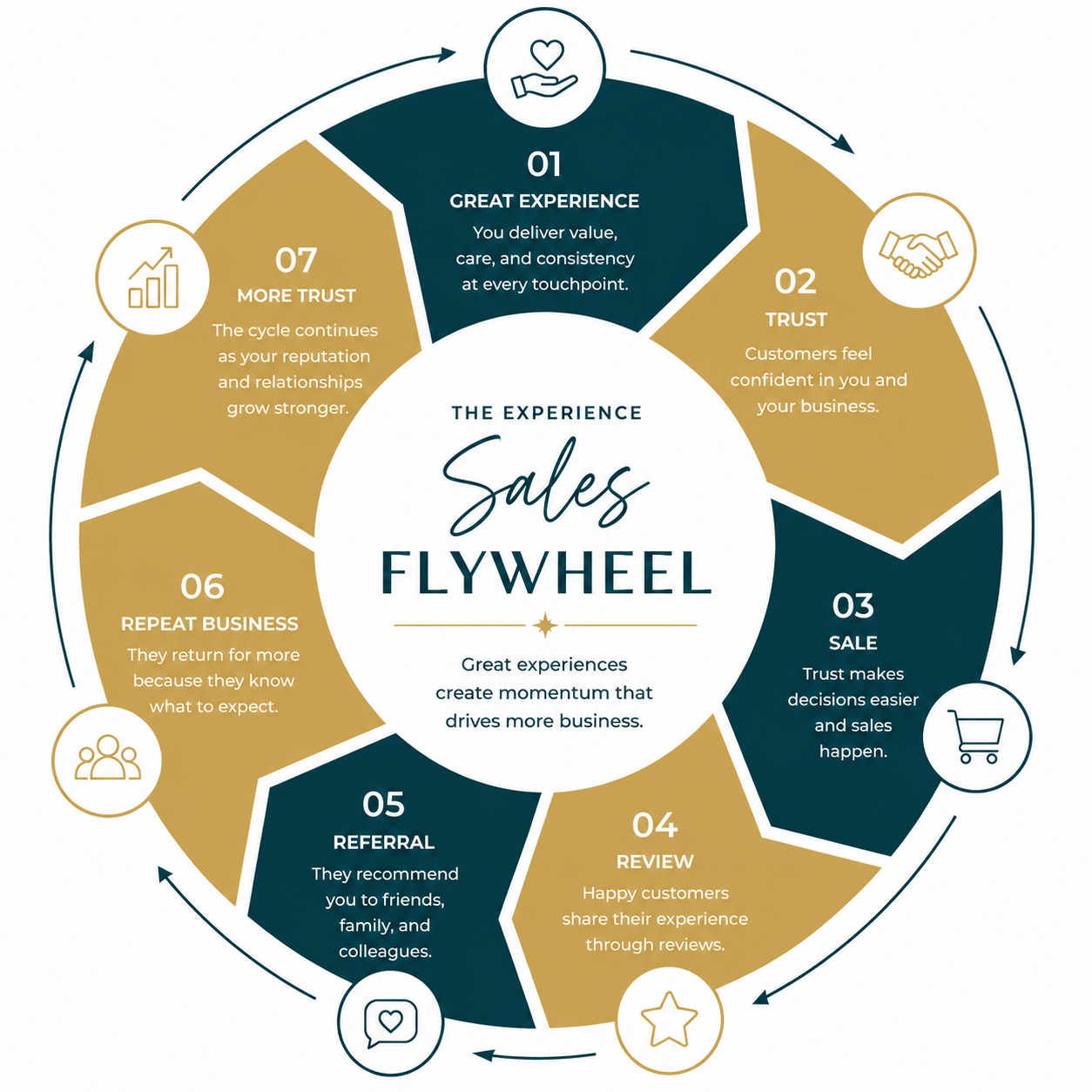
A customer has a great experience.
They become more confident buying.
They leave proof behind through reviews.
They recommend you.
They return.
Those actions create trust for future customers.
Then the cycle repeats.
That's why customer experience isn't merely a "soft" business concept.
It creates measurable outcomes.
Sales.
Reviews.
Retention.
Referrals.
Reputation.
Revenue.
And the stronger that flywheel becomes, the less every new customer relationship has to begin with:
"Let me convince you we're good."
Your reputation begins speaking before you do.
Your Customers Should Help Make Your Marketing Easier
That's ultimately one of the biggest benefits of a great customer experience.
Your marketing no longer depends entirely on you talking about how good your business is.
Your customers start helping.
Their reviews help.
Their referrals help.
Their testimonials help.
Their repeat business helps.
Their conversations with friends help.
Their social posts help.
Their loyalty helps.
Now you're not the only one telling the story.
That's when customer experience becomes marketing.
And marketing becomes easier because the promise you're making publicly is supported by what customers are actually experiencing privately.
Want to Know Where Your Customer Journey Is Breaking Down?
Maybe your customer experience is already one of your strongest assets.
Or maybe you're getting plenty of visibility but something between being discovered and becoming a customer isn't working the way it should.
That's exactly why we created the Visibility Assessment.
It helps you evaluate your business across four stages:
Get Found → Build Trust → Create Conversations → Generate Revenue
So you can identify whether the problem is attracting attention, establishing credibility, creating opportunities, or turning those opportunities into customers.
Take the Visibility Assessment →
And if you want help looking more closely at your current customer journey and deciding what to prioritize, book a Visibility Strategy Call and we'll identify the opportunities with the greatest potential impact.
Book a Visibility Strategy Call →
Continue Building Your Visibility
Why Customers Aren't Leaving Google Reviews
If you're creating great experiences but your Google reputation doesn't reflect it, this free guide will help you identify what's preventing more customers from leaving reviews.
The 4 Stages of Business Visibility
Learn how getting found, building trust, creating conversations, and generating revenue work together throughout your customer journey.
Read The 4 Stages of Business Visibility →
The Bare Minimum Sales Pitch
If your customer experience has already done much of the trust-building, learn how to recognize when a potential customer is ready to buy—and stop talking them out of the sale.
Read The Bare Minimum Sales Pitch →
The Visibility Letter
Get practical strategies for customer experience, visibility, sales, Google reviews, events, and turning attention into business growth.
Frequently Asked Questions About Customer Experience Strategy
What is a customer experience strategy?
A customer experience strategy is an intentional plan for how customers interact with and experience a business throughout their journey. It can include discovery, communication, booking, purchasing, service delivery, support, follow-up, reviews, retention, and referrals.
Why is customer experience important for sales?
Customer experience affects trust and buying confidence. When a business is responsive, easy to work with, clear, professional, and consistent, potential customers experience less friction and uncertainty when deciding whether to buy.
How can customer experience increase revenue?
A strong customer experience can contribute to higher conversion rates, stronger customer retention, repeat purchases, more positive reviews, referrals, and greater customer loyalty. Those outcomes can increase revenue without relying entirely on acquiring new customers.
What makes a good customer experience?
A strong customer experience is typically clear, consistent, easy, responsive, and aligned with what the business promises. Customers should understand what happens next, feel heard and respected, receive reliable communication, and experience a service that matches their expectations.
How do customer reviews relate to customer experience?
Reviews are one of the ways customers publicly describe their experience with a business. Positive experiences can generate reviews that provide social proof and help future customers evaluate whether they can trust the business.
What is the difference between customer service and customer experience?
Customer service usually refers to specific interactions where a business supports or assists a customer. Customer experience is broader and includes the customer's entire relationship with the business—from discovery and initial inquiry through purchasing, service delivery, follow-up, and future interactions.
Can customer experience be a competitive advantage?
Yes. A consistent customer experience can differentiate businesses offering similar products or services. Customers may choose a company because it is easier to work with, more responsive, more personalized, more trustworthy, or creates a better overall experience than competitors.
How can a small business improve customer experience?
Start by reviewing the entire customer journey. Look for unclear communication, slow response times, confusing processes, unnecessary steps, weak follow-up, or mismatches between your marketing promises and the actual experience. Often, improving several small points of friction can have a significant impact.


