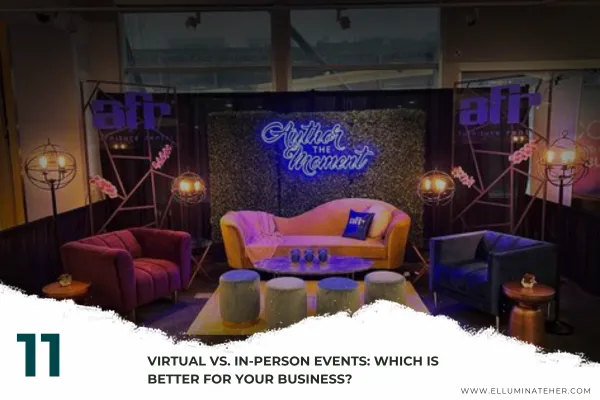
Virtual vs. In-Person Events: Which Is Better for Your Business?
Virtual vs. In-Person Events: Which Is Better for Your Business?
Quick Answer: Neither virtual nor in-person events are automatically better. The right format depends on your business objective, audience, budget, offer, and the experience you need to create. Virtual events can expand reach and reduce logistical barriers, while in-person events can accelerate trust, relationships, and engagement. Start with the business goal, then choose the format that best supports it.
Before You Choose a Venue or Open Zoom, Start Here
Hosting events is still one of my favorite ways to generate visibility, build relationships, create community, and bring potential customers closer to your business.
But when business owners decide they want to host an event, one of the first questions is usually:
Should I host it virtually or in person?
And my answer is:
What are you trying to accomplish?
Because I don't believe your event format should be the first decision you make.
Your objective should be.
Are you trying to reach people across the country?
Build deeper relationships with a local audience?
Generate leads?
Launch an offer?
Create community?
Demonstrate your expertise?
Get potential customers into your physical location?
Create an intimate environment for higher-level conversations?
Generate revenue?
The answer matters.
A virtual summit and an intimate 30-person dinner can both be incredible marketing strategies.
But they don't create the same experience.
And they shouldn't be expected to produce the same results.
That's why the real question isn't:
Virtual or in person—which is better?
It's:
Which experience gives me the best opportunity to accomplish what this event is supposed to do for my audience and my business?
That's where I want us to start.
Events Should Have a Job
One of the biggest shifts I've made in the way I think about events is that I no longer look at the event itself as the goal.
Hosting the event isn't the win.
The event should have a job within your larger business strategy.
Maybe its job is visibility.
Maybe you want 500 new people to discover your brand.
Maybe its job is trust.
You want potential customers to spend two hours experiencing your expertise.
Maybe its job is conversation.
You want to get the right prospects into an environment where you can actually meet them.
Maybe its job is revenue.
You have an offer and the event is intentionally designed to create qualified sales opportunities.
Sometimes an event can accomplish several of these things at once.
But you need to know what matters most before deciding how to deliver it.
Because format should follow strategy.
With that in mind, let's talk about what virtual and in-person events each do particularly well.
Why Consider a Virtual Event?
Virtual events completely changed what was possible for businesses.
And yes, we can thank COVID for forcing many of us to get very creative with virtual spaces.
Suddenly we realized we didn't have to get everyone into the same ballroom to create an experience.
Someone could be sitting in Sacramento while another person joined from Atlanta, Toronto, London, or their kitchen table.
That opened up an entirely different kind of visibility.
I've experienced this myself.
I remember hosting a virtual summit and realizing someone from Canada had registered.
Canada!
I was amazed.
Here I was with my little ol' event bringing together people who didn't even live in the same country.
It made me think differently about reach.
If you have a business with the potential to serve people beyond your immediate city, a virtual event can create opportunities that a local event simply can't.
1. Virtual Events Can Expand Your Reach
The obvious advantage is geography.
Your audience doesn't have to:
Book a flight.
Pay for a hotel.
Drive across town.
Find childcare for an entire day.
Or live anywhere near you.
They need a device and an internet connection.
That lower barrier can give you access to a much larger potential audience.
For consultants, coaches, educators, speakers, membership communities, professional service providers, and businesses that can serve customers remotely, that's significant.
But I wouldn't automatically interpret global reach as better reach.
I'd ask:
Do you actually need a global audience?
If you own a med spa in Sacramento, getting 5,000 registrants from around the world may look impressive but do very little for your business.
Five hundred local people might be substantially more valuable.
Reach only matters when you're reaching people who can realistically become part of your business ecosystem.
2. Virtual Events Can Reduce Costs and Complexity
One of the biggest advantages of virtual events is that you remove many of the expenses associated with physical events.
No ballroom.
No catering minimum.
No tables and chairs.
No travel expenses for your team.
No parking negotiations.
No wondering whether you ordered enough coffee for 200 people.
That can make virtual events much more accessible for businesses with smaller event budgets.
But here's where I wouldn't automatically pocket every dollar you saved.
Invest some of it back into the experience.
Better production.
A strong virtual platform.
Great speakers.
Professional graphics.
Intentional marketing.
Interactive elements.
Thoughtful attendee communication.
Post-event follow-up.
Virtual does not have to mean cheap.
The delivery method changed. The customer experience still matters.
3. Virtual Events Offer Convenience and Flexibility
Your audience is busy.
Virtual events can make participation easier.
Someone can attend during a lunch break.
Join from home.
Participate while traveling.
And when appropriate, recordings can extend the life of the content beyond the live event.
But I would still give people a compelling reason to show up live.
Because a recording delivers information.
A live event creates interaction.
The questions.
The chat.
The conversations.
The networking.
The energy of experiencing something while it's happening.
Those are much harder to recreate through a replay.
If community and conversation matter to your event objective, design the virtual experience around participation rather than simply broadcasting information through a screen.
The Power of In-Person Events
As much as I appreciate what virtual events make possible, there is still something I love about getting people into the same room.
The energy is different.
The conversations are different.
The experience is different.
I've had people bring up events I hosted years later because the experience stayed with them.
That's powerful.
They may not remember every slide.
They may not remember exactly what the speaker said.
But they remember how the room made them feel.
They remember who they met.
They remember the conversation at lunch.
They remember the moment they realized:
"These are my people."
That's difficult to replicate through a screen.
1. In-Person Events Can Accelerate Relationships
There's only so much relationship-building that can happen through likes, comments, emails, and Zoom squares.
Put people in the same room and something changes.
They talk before the program starts.
They sit together at lunch.
They introduce themselves during breaks.
They meet the person sitting beside them.
They stay after the event talking.
And those moments create relationships you couldn't necessarily plan.
I've seen women who met at one of my first events in 2019 remain connected years later.
That's one of my favorite things about events.
The host doesn't have to be the only valuable connection in the room.
You create the environment.
Then people begin creating value for one another.
For businesses that want to build community, strengthen customer relationships, develop referral partnerships, or create deeper connections with potential customers, that's incredibly valuable.
2. In-Person Events Create an Experience People Can Feel
This is where in-person events have an enormous advantage.
You have access to the environment.
The lighting.
Music.
Food.
Scent.
Decor.
Room layout.
Signage.
Activities.
Touchpoints.
You can create an entire world around your brand for a few hours.
And if your audience is women, you already know many of us love a reason to show up and show out.
Give us a beautiful space.
Tell us the dress code.
Give us something to experience.
We'll make a day out of it. 😂
But the experience shouldn't simply be beautiful for the sake of being beautiful.
Ask:
What do I want people to feel when they walk into this room?
Welcomed?
Inspired?
Relaxed?
Energized?
Exclusive?
Connected?
Supported?
The physical environment gives you another tool for communicating your brand without saying a word.
3. In-Person Events Can Create Deeper Engagement
We've all done it.
You're on a webinar.
Your camera is off.
You're checking your email.
Then Slack.
Then Instagram.
Then somebody walks into the room and asks you a question.
Twenty minutes later you realize you have no idea what the speaker has been talking about.
😂
Virtual events have to compete with everything happening around the attendee.
An in-person event can remove some of those distractions.
People have physically decided:
I'm here.
That commitment matters.
They're more likely to participate.
Ask questions.
Talk to people.
Experience the program.
And if your event is connected to an offer, that deeper engagement can also create more meaningful sales conversations.
Virtual vs. In-Person Events: How Do You Choose?
Now we get to the actual decision.
And I wouldn't make it based on which format sounds more exciting.
I'd evaluate these five things.
1. What Is the Business Goal?
Start here.
Always.
If your primary objective is reaching a geographically dispersed audience, virtual may make more sense.
If you're trying to deepen relationships with a local community, in person may be stronger.
If you're launching a digital program, a virtual workshop might create the perfect bridge.
If you're opening a new location, getting local potential customers physically into the space may be much more valuable.
Don't choose the format and then try to force your objective into it.
Choose the objective and build the event around it.
2. Where Is Your Audience?
This is different from asking how large your audience is.
You can have 20,000 followers and still struggle to fill a 100-person local event if those followers are scattered across the country.
Look at where the people you actually want to reach live.
If your customers are geographically concentrated, an in-person strategy becomes more realistic.
If they're spread out, virtual removes a major barrier.
And remember:
A larger audience isn't automatically a better audience.
I'd rather have 50 right-fit potential customers than 500 people who will never buy what the business sells.
3. What Experience Does the Audience Need?
Some topics work beautifully online.
Education.
Training.
Panels.
Information-heavy sessions.
Demonstrations.
Other objectives benefit from physical presence.
Networking.
Immersive experiences.
Hands-on activities.
Relationship-building.
Local community development.
Premium experiences.
Ask yourself:
What needs to happen between these people for this event to work?
The answer may make the format obvious.
4. What Can You Realistically Invest?
Yes, budget matters.
But don't only consider money.
Consider:
Time.
Team capacity.
Technology.
Marketing.
Production.
Travel.
Venue logistics.
Customer support.
Sales support.
Follow-up.
An inexpensive event that your team doesn't have the capacity to execute well isn't necessarily the better choice.
And a more expensive in-person event can absolutely make sense if the business case supports the investment.
Which brings us to the question I especially want business owners asking:
What does this event need to produce for the investment to make sense?
That's a much more useful question than simply:
"How cheaply can I host this?"
5. How Will This Event Create Business Opportunities?
This is where we move beyond event planning and into event strategy.
What happens because someone attended?
Do they join your email list?
Book a consultation?
Visit your business?
Experience your service?
Become part of your community?
Meet your team?
Learn about an offer?
Schedule an appointment?
Refer someone?
Buy?
Your event doesn't necessarily have to make an immediate sale to be valuable.
But it should create movement.
Because if you're using events as a business growth strategy, you need to know where you're trying to move people next.
Don't Confuse Registration With Results
This is one of the biggest mistakes businesses make with both virtual and in-person events.
We become obsessed with registration numbers.
"We got 500 registrations!"
Great.
How many attended?
How many were right-fit people?
How many engaged?
How many conversations happened?
How many leads were generated?
How many people took the next step?
What happened afterward?
The same is true in person.
A sold-out room is exciting.
But a sold-out room isn't automatically a successful business event.
Attendance tells you who showed up. It doesn't tell you what the event produced.
That's why your event goals need to be established before the marketing begins.
If the goal is awareness, measure awareness.
If the goal is leads, measure leads.
If the goal is membership, measure membership conversations and conversions.
If the goal is sales, measure sales.
If the goal is customer retention, measure that.
The metrics should match the job you gave the event.
Your Marketing Strategy Should Change With the Format
Another mistake I see is businesses marketing virtual and in-person events exactly the same way.
They aren't the same commitment.
Someone deciding whether to click a Zoom link from their couch is making a different decision from someone deciding whether to get dressed, drive 45 minutes, pay for parking, and spend four hours at your venue.
Your messaging should reflect that.
For a virtual event, convenience, accessibility, expertise, and immediate value may be especially compelling.
For an in-person event, the room itself becomes part of the value.
Who will be there?
What will they experience?
Why is it worth leaving home?
What conversations can happen there that can't happen anywhere else?
Why does someone need to be in that room?
Those questions should shape your event marketing.
And they need to be answered long before the week of the event.
A strategic 90-Day Marketing Experience gives you time to build awareness, activate partners, reach audiences beyond your existing social media followers, create compelling reasons to attend, and build momentum instead of trying to fill the room through last-minute posts.
What About Revenue?
Whether your event is virtual or in person, if revenue is one of your objectives, you need a strategy for it.
Not:
"I'll mention my offer at the end and see what happens."
A strategy.
What are you offering?
Who is it for?
When will attendees learn about it?
How does the event naturally lead to it?
How can interested attendees ask questions?
What's the next step?
Who follows up?
Those questions matter in both environments.
The mechanics may change.
At an in-person event, the sales conversation might happen at the back of the room.
At a virtual event, it might happen through a breakout room, chat, booking link, application, or scheduled consultation.
But the principle remains the same:
Visibility without sales is just expensive exposure.
If the event is intended to generate revenue, don't leave the revenue strategy until the event is already happening.
For in-person events where you need dedicated support turning attendee interest into sales conversations, an Event Revenue Partner can help create an intentional plan for what happens before, during, and after the event.
So, Which One Should You Choose?
Let's make this simple.
Consider a virtual event when:
Your ideal audience is geographically dispersed.
Accessibility and convenience are priorities.
Your content is primarily educational or informational.
You want to reduce physical-event logistics.
Your offer can be delivered or purchased remotely.
Broader reach matters more than creating a physical experience.
Consider an in-person event when:
Your audience is concentrated in a specific market.
Relationship-building is a major objective.
The physical experience is part of the value.
Networking matters.
You want attendees to experience your brand, team, location, or service.
Face-to-face sales conversations could meaningfully support the business objective.
And sometimes?
You may use both.
A virtual workshop could build interest for an in-person experience.
An in-person event could lead attendees into an ongoing virtual community.
A virtual information session could prepare people for a live conference.
You don't have to choose one format forever.
Choose the format that makes sense for this objective, this audience, and this moment in your business.
Start With Strategy, Not Format
The best event isn't automatically the biggest one.
It isn't automatically the most beautiful.
It isn't the one with the most speakers.
And it isn't automatically virtual or in person.
It's the event designed to do its job.
Start with:
What are we trying to accomplish?
Who needs to be there?
What do we want them to experience?
What should happen because they attended?
How will we know whether it worked?
Then choose the format.
Because an event should never exist simply because you wanted to host one.
It should fit into the larger journey you're creating for your customers.
Get the right people into the experience.
Give them a reason to trust your business.
Create opportunities for meaningful conversations.
And when revenue is the objective, give those conversations somewhere to go.
That's event marketing with intention.
Planning an Event? Don't Start With the Flyer.
Before you start designing graphics, posting on Instagram, or worrying about ticket sales, get clear on how your event fits into your larger marketing strategy.
If you already have an event on the calendar and need support getting the right people into the room, ElluminateHER's 90-Day Marketing Experience helps build the visibility and promotional strategy around your event.
And if you're still trying to determine what kind of visibility strategy your business needs, start with the Visibility Assessment.
It will help you identify where your business may be getting stuck across four stages:
Get Found → Build Trust → Create Conversations → Generate Revenue
Take the Visibility Assessment →
If you're ready for more personalized support, you can also book a Visibility Strategy Call and we'll talk through your goals, audience, and where your event fits into the larger customer journey.
Book a Visibility Strategy Call →
Continue Building Your Event Strategy
Reach Your Audience Guide
If you've decided to host an event but don't want to rely entirely on social media to fill it, download the Reach Your Audience Guide for 15 offline strategies you can use to promote your event.
Vision. Strategy. Execution. Guide
Before you start planning all the details, make sure the event itself is aligned with your business goals and has a clear strategy behind it.
The Visibility Letter
Get practical conversations about visibility, events, customer experience, and turning attention into business growth delivered to your inbox.
Frequently Asked Questions About Virtual vs. In-Person Events
Are virtual events or in-person events better?
Neither format is universally better. Virtual events can provide greater geographic reach, accessibility, and flexibility, while in-person events can create deeper relationships, immersive experiences, and face-to-face conversations. The right format depends on your audience and business objective.
Are virtual events still effective?
Yes, particularly when the audience is geographically dispersed or the event focuses heavily on education, training, or information. The experience should still be intentionally designed for interaction and engagement rather than simply moving an in-person presentation onto a video platform.
What are the advantages of in-person events?
In-person events can facilitate stronger face-to-face relationships, networking, immersive brand experiences, deeper engagement, community building, and natural opportunities for conversations between businesses and potential customers.
Are in-person events more expensive than virtual events?
They often have higher direct expenses because of costs such as venues, catering, staffing, production, travel, rentals, and physical materials. However, cost alone shouldn't determine the format. Businesses should consider the potential return and whether the experience supports the event's larger objective.
Can virtual events generate leads?
Yes. Virtual events can generate leads through registration, live engagement, downloads, applications, consultations, breakout sessions, chat interactions, and post-event follow-up. A lead-generation strategy should be established before the event rather than relying solely on registration numbers.
How far in advance should I market an event?
The appropriate timeline depends on the event's size, audience, price, location, and commitment required from attendees. Events that require travel, higher ticket prices, partnerships, or significant time commitments generally need a longer promotional runway. ElluminateHER uses a 90-day event marketing approach to create time for awareness, partnerships, audience outreach, and promotional momentum.
Can an event be both virtual and in person?
Yes. A hybrid or multi-format strategy can make sense when it supports the business objective. For example, a virtual session can build interest before an in-person event, while an in-person experience can lead into an ongoing virtual community or program. The formats should complement one another rather than being combined simply for the sake of offering both.


