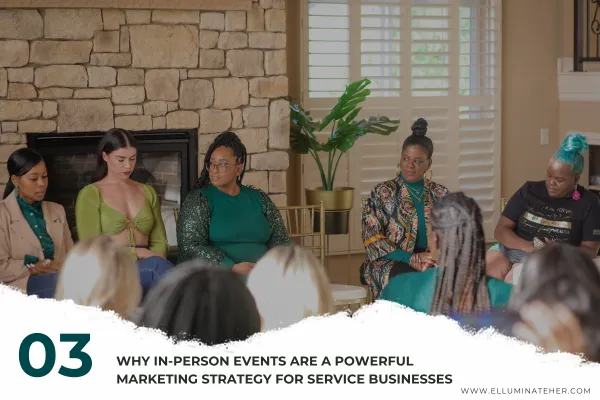
Why In-Person Events Are Still One of the Most Powerful Marketing Strategies for Service Businesses
Why In-Person Events Are Still One of the Most Powerful Marketing Strategies for Service Businesses
Quick Answer: In-person event marketing gives service businesses something digital marketing can't completely replicate: the opportunity to build relationships and trust in real time. Strategic events can help businesses increase visibility, connect with potential customers, strengthen their communities, create qualified sales conversations, and ultimately generate revenue.
"In an era where so many business interactions happen online, there is still something powerful about meeting people in person." — ElluminateHER
We Have More Ways to Connect Than Ever. So Why Do We Feel So Disconnected?
We can run an entire business without ever leaving our homes.
We can send emails.
Host Zoom calls.
Post on social media.
Send DMs to complete strangers.
Sell products to someone we've never met.
Build communities with people living thousands of miles away.
And I think that's incredible.
But I also think we've learned something along the way:
Digital connection and human connection aren't always the same thing.
There is something different about sitting across the table from someone.
Hearing their story.
Laughing together.
Asking a question and watching their face change when something finally clicks.
Having the conversation after the presentation that never would have happened through an Instagram comment.
That's one of the reasons I continue to believe so deeply in the power of events.
And I'm not just talking about hosting a 500-person conference.
An event could be a workshop.
A networking mixer.
A luncheon.
A customer appreciation experience.
A seminar.
A retreat.
A pop-up.
A grand opening.
Even an intimate gathering of 15 potential customers.
The size of the room isn't what makes an event powerful.
It's what you intentionally create inside the room that matters.
When done strategically, an event isn't simply something nice to host.
It becomes part of your marketing ecosystem.
It helps people discover you.
It gives them an opportunity to experience your business.
It accelerates trust.
It creates conversations.
And those conversations can eventually create customers.
That's why I believe in-person event marketing deserves a place in the visibility strategy of more service businesses.
Events Aren't Separate From Your Marketing Strategy
This is where I think businesses sometimes get events wrong.
They treat the event as the strategy.
Book the venue.
Create the flyer.
Post it on Instagram.
Sell tickets.
Host the event.
Take some pictures.
Go home.
Done.
But the event itself should only be one piece of a much larger marketing strategy.
At ElluminateHER, we believe:
Visibility should build trust.
Trust should create conversations.
Conversations should create customers.
Customers should create sustainable business growth.
That's the foundation of our Visibility That Converts Framework, and events can play an incredibly powerful role within that customer journey.
The marketing before your event creates visibility.
The experience inside the room builds trust.
The interactions create conversations.
And your sales and follow-up strategy create opportunities for revenue.
Suddenly, you're not just "throwing an event."
You're creating a marketing experience.
And that's a very different way to think about events.
1. In-Person Events Create Visibility Beyond Social Media
One of the biggest mistakes I see businesses make is depending too heavily on social media for visibility.
You post.
Your existing followers see it.
Maybe.
You post again.
Another percentage of the same audience sees it.
Maybe you reach a few new people.
Then you repeat the process.
Events give you a reason to expand beyond your existing digital bubble.
When you're intentionally marketing an event, you can create partnerships with complementary businesses, connect with professional organizations, leverage community calendars, work with speakers and sponsors, invite past customers, reach out to local media, utilize email lists, activate referral partners, and personally invite people who should be in the room.
Now your business isn't relying solely on an algorithm to determine who discovers you.
You're intentionally creating visibility.
That's why the marketing strategy surrounding an event matters just as much as what happens on event day.
A strong 90-Day Marketing Experience can turn the months leading up to your event into an opportunity to continually introduce your brand to new audiences instead of waiting until the final few weeks to start promoting.
2. Events Accelerate Trust
Think about how long it sometimes takes to build trust online.
Someone discovers your Instagram account.
They follow you.
They watch a few Stories.
They read some posts.
They visit your website.
They join your email list.
They watch you for six months.
And eventually they decide:
"Okay. I think I trust her."
Now compare that with spending two hours in the same room.
They hear you speak.
They watch you interact with other people.
They experience your personality.
They see how knowledgeable you are.
They ask you questions.
They experience your brand instead of simply reading about it.
You can accomplish in a few hours what might take months online.
That's why events can be particularly powerful for service businesses.
When you're selling expertise, transformation, access, or a high-value service, you are part of the product.
People aren't only evaluating what you sell.
They're evaluating whether they trust you to deliver it.
And there is something incredibly powerful about being able to experience that trust in person.
3. Events Create Real Relationships
One of the oldest sayings in sales is:
People buy from people.
I'd take that one step further.
People buy from people they trust, remember, and feel connected to.
That's where events shine.
Some of the most valuable moments at an event don't happen from the stage.
They happen during the coffee break.
At the registration table.
During lunch.
Standing in line.
After the panel.
During the conversation that starts with:
"Wait...what do you do?"
Those conversations matter.
Because relationships are still one of the greatest currencies in business.
A stranger can become a connection.
A connection can become a referral partner.
A referral partner can introduce you to a customer.
A customer can become an advocate.
And an advocate can introduce your business to an entirely new network.
That's difficult to measure with an Instagram impression.
But it can transform a business.
4. Events Create Community Around Your Brand
There is a difference between having an audience and having a community.
An audience watches you.
A community participates with you.
Events give your customers, prospects, partners, and supporters a reason to gather around a shared experience.
That's especially valuable for businesses where community is part of the brand.
When people meet each other through your business, something interesting happens.
Your brand becomes the connector.
They remember where they met.
They remember the conversation.
They remember the experience.
They remember who brought everyone together.
And if you consistently create valuable experiences, people don't simply attend your events.
They begin looking forward to them.
That's when an event can evolve from a one-time marketing tactic into a recognizable part of your brand.
5. Events Help You Stand Out in a Crowded Market
Let's be real.
There is a lot of noise online.
Your potential customers are seeing advertisements, emails, Reels, TikToks, LinkedIn posts, newsletters, podcasts, webinars, and sales messages every single day.
Everyone is trying to get their attention.
An intentional in-person experience gives you an opportunity to create something people actually remember.
Instead of telling someone:
"Our company cares about customer experience."
Show them.
Instead of saying:
"We're experts."
Teach them something valuable.
Instead of posting:
"We believe in community."
Create the room where the community meets.
Instead of telling people what your brand represents, let them experience it.
That experience becomes part of your competitive advantage.
6. Events Create Better Sales Conversations
This is one of the biggest reasons I love events.
They create natural opportunities for sales conversations without every interaction feeling like a sales pitch.
Someone hears you speak.
They have a question.
They approach you afterward.
You start talking.
You learn about their business.
You discover what they're struggling with.
They ask how you help.
Now you're not cold selling.
You're having a conversation.
And because they've already experienced your expertise, the conversation starts from a completely different place.
This is also why I don't believe businesses should wait until the end of an event to start thinking about sales.
Your revenue strategy should begin before anyone walks through the door.
At ElluminateHER, that's the foundation of our Event Revenue Method:
Align → Court → Convert → Continue
Align
Before the event, determine what you're selling, who the right customer is, what conversations need to happen, and what the natural next step should be.
Court
During the event, focus on meaningful conversations rather than immediately trying to sell everyone in the room.
Convert
When someone is qualified and interested, guide them toward the appropriate next step.
Continue
After the event, follow up intentionally.
Because some of the most valuable sales from an event happen after everyone goes home.
This is exactly why we say:
Visibility without sales is just expensive exposure.
A packed room looks great in photos.
But if your business objective is growth, attendance cannot be the only measurement of success.
Your event should create relationships, opportunities, conversations, customers—or ideally, all four.
And when you need support turning those opportunities into actual sales, an Event Revenue Partner can help you create an intentional strategy for what happens before, during, and after your event.
7. Events Give You Marketing Content Long After They're Over
There's another benefit businesses often overlook.
Your event can become a content engine.
One strategic event can generate:
Professional photos
Customer testimonials
Speaker clips
Educational videos
Behind-the-scenes content
Attendee interviews
Social proof
Email content
Blog topics
Google Business Profile photos
Future event promotion
Instead of creating content from scratch every week, you're documenting real people experiencing your brand.
That's powerful marketing.
And more importantly, it's believable.
Future customers aren't simply seeing you tell them your business is great.
They're seeing other people participate in it.
But Hosting an Event Isn't Enough
This is the part I want business owners to understand.
An event doesn't automatically create business growth simply because you hosted one.
I've seen beautiful events with gorgeous decor, amazing speakers, incredible food—and no clear strategy for what happens next.
No lead capture.
No follow-up plan.
No intentional sales conversations.
No measurement.
No customer journey.
Everyone has a wonderful time...
and the business owner walks away wondering whether the event was actually worth the money.
That's why we have to stop separating event planning from event marketing and event revenue.
Ask yourself:
How will people discover this event?
Why should they attend?
What do I want them to experience?
What conversations do I want to create?
What should an interested attendee do next?
How will we follow up?
How will we measure whether the event worked?
Those questions turn an event from an expense into a business strategy.
Is an In-Person Event Right for Your Business?
You don't need to host an event simply because everyone else is doing it.
An event makes sense when it supports a clear business objective.
Maybe you want to generate qualified leads.
Maybe you want potential customers to experience your expertise.
Maybe you're launching a new location.
Maybe you're building a local community.
Maybe you're introducing a new offer.
Maybe you want to deepen relationships with existing customers.
Maybe you want to create strategic partnerships.
Start with the objective.
Then design the event around it.
That's what strategic event marketing looks like.
Stop Hosting Events Just to Host Events
Don't just create a room full of people.
Create visibility.
Create trust.
Create conversations.
Create community.
Create opportunities.
And create a clear pathway for the right attendees to become customers.
Because a successful event shouldn't simply leave people saying:
"That was fun."
It should leave them saying:
"I need to know more about this business."
That's the difference between simply hosting an event and using events as part of your business growth strategy.
A beautiful venue is great.
A packed room is exciting.
Amazing photos are valuable.
But none of those things alone tell you whether your event actually worked.
Did new people discover your business?
Did you strengthen relationships?
Did attendees leave trusting your brand more than they did when they arrived?
Did meaningful conversations happen?
Did you capture leads?
Did people take the next step?
Did the event create opportunities that can eventually turn into revenue?
Those are the questions I want more business owners asking.
Ready to Make Your Next Event Work Harder for Your Business?
If you're planning an event and want it to do more than fill a room, ElluminateHER can help you build the visibility and revenue strategy behind it.
Our 90-Day Marketing Experiences help businesses strategically promote their events, reach the right audiences, and create momentum before event day.
If you already know how to fill the room but need support turning attendees into customers, our Event Revenue Partner service focuses on what happens before, during, and after the event.
We use The Event Revenue Method:
Align → Court → Convert → Continue
So you're not waiting until the event is over to ask whether it generated business.
You're preparing for revenue before the doors ever open, creating meaningful connections in the room, guiding qualified attendees toward the right next step, and continuing those conversations after the event.
Book a Visibility Strategy Call to talk through your upcoming event and determine where ElluminateHER can best support your goals.
Continue Building Your Visibility
If you're not ready for a strategy call yet, continue building your visibility with these resources:
The Visibility Assessment
Discover where your business may be losing visibility, trust, conversations, or revenue—and identify the areas with the greatest opportunity for growth.
[Take the Visibility Assessment →]
Events Make Cents Podcast
Continue learning how to use events as more than a one-day experience and start thinking about them as part of your larger marketing and revenue strategy.
[Listen to Events Make Cents →]
The Visibility Letter
Get practical strategies for getting found, building trust, creating conversations, and turning visibility into customers delivered straight to your inbox.
[Join The Visibility Letter →]
Frequently Asked Questions About In-Person Event Marketing
What is in-person event marketing?
In-person event marketing uses live experiences such as workshops, conferences, networking events, pop-ups, grand openings, customer events, and other gatherings to increase brand awareness, build relationships, generate leads, and create sales opportunities.
Are in-person events still effective for marketing?
Yes. In-person events allow businesses to create face-to-face relationships, demonstrate expertise, build trust, and give prospective customers an opportunity to experience a brand in ways that digital marketing alone can't always replicate.
How can events generate leads for a service business?
Events can generate leads through registrations, strategic partnerships, attendee conversations, educational experiences, networking, demonstrations, and intentional post-event follow-up. The key is having a lead-generation strategy before the event instead of waiting until event day to decide what happens next.
Do I need a large audience to host a successful event?
No.
A small room filled with the right people can be far more valuable than a large audience of people who aren't aligned with your business.
The goal isn't simply attendance.
It's getting the right people into the room.
How far in advance should you market an event?
The right promotional timeline depends on the size, audience, price, and type of event. Larger or higher-commitment events generally require a longer promotional runway.
ElluminateHER's event marketing engagements are structured as 90-Day Marketing Experiences because strategic promotion works best when there is enough time to build awareness, develop partnerships, establish trust, and create momentum before event day.


