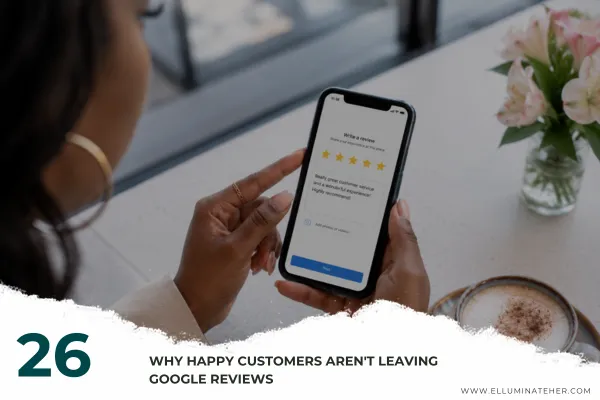
Why Happy Customers Aren't Leaving Google Reviews
Why Happy Customers Aren't Leaving Google Reviews—and What Actually Gets Them to Do It
Quick Answer: Happy customers usually don't skip reviews because they don't care. They forget, get busy, don't know how important reviews are to your business, or never receive a clear and easy request. The solution is a consistent review system: ask at the right moment, explain why it matters, make leaving the review easy, and follow up when needed.
Your Customers Love You. So Where Are the Reviews?
This is one of the most frustrating things about running a good business.
Your customer tells you:
"You were amazing."
They thank you.
They tell you they're sending their sister.
They say they're definitely coming back.
They may even stand there for five minutes telling you how much better their experience was with you than the business they tried before.
And then you open Google two weeks later...
Nothing.
No review.
No five stars.
No glowing paragraph about how wonderful you are.
😂
And I think business owners sometimes take that personally.
They said they loved us. Why didn't they leave a review?
But after spending years intentionally growing Google reviews in the aesthetics industry, I've learned something:
Happy customers and customers who leave reviews are not automatically the same group of people.
You can provide an incredible experience and still have a Google profile that doesn't reflect it.
Not because your customers are lying when they tell you they love you.
Not because your service isn't worth reviewing.
Usually, there's a much simpler reason.
You left the review to chance.
That was one of the biggest lessons I learned while helping our studio grow beyond 850 Google reviews and consistently generate roughly 25 new reviews a month.
We didn't magically have customers who were more generous than everybody else's.
We got intentional.
And that changed everything.
Most Customers Aren't Thinking About Your Google Reviews
I want you to think about the last time you had a great experience somewhere.
Maybe you had your hair done.
Went to dinner.
Had your car serviced.
Visited a doctor.
Worked with a contractor.
Bought something from a local shop.
You walked away happy.
Did you immediately think:
"You know what I need to do right now? Go write them a Google review."
Probably not. 😂
You thought about your next appointment.
Your kids.
Dinner.
That email you forgot to send.
The 14 notifications on your phone.
Getting back to work.
Life.
That's what's happening with your customers too.
They're not walking away thinking:
"I refuse to support this business by leaving a review."
They're walking away thinking:
"That was great."
Then life keeps moving.
And unless your business creates a natural next step, that wonderful intention disappears.
That's why I don't believe you should build your review strategy around:
"Hopefully they'll remember."
Hope is not a system.
Customers Also Don't Know What a Review Can Mean to Your Business
This is another thing I learned from actually asking people for reviews.
Business owners understand the value.
Customers often don't.
A customer may think:
"They already have 100 reviews. They don't need mine."
Or:
"They're obviously doing well."
Or:
"I'll do it later."
They may not understand that the review they're considering skipping could be exactly what helps another potential customer feel confident enough to choose you.
That's why I don't have a problem telling customers why a review matters.
Not guilt.
Not pressure.
Just context.
Something as simple as:
"If you had a great experience today, would you mind leaving us a Google review? Reviews really help other people feel confident choosing us."
Now the customer understands the purpose.
You're not simply asking for a favor.
You're showing them how their experience can help someone else make a decision.
And I've found people are often very willing to support businesses they genuinely enjoyed working with.
They just need to be asked.
The Difference Between Hoping for Reviews and Building a Review System
This is where I think a lot of businesses get stuck.
They've technically tried asking.
There's a QR code by the register.
There's a review card on the desk.
Maybe the receipt has a link.
Someone occasionally says:
"If you have time, leave us a review!"
Then every three months someone looks at the Google profile and says:
"We need more reviews."
So everybody gets serious for four days.
Then the whole thing disappears again.
That's not a review strategy.
That's a review emergency. 😂
A strong review process should become part of the normal customer journey.
Just like:
Booking.
Payment.
Service delivery.
Follow-up.
The review request needs a place too.
Because consistency is what allows your reputation to grow over time.
Why Common Review Tactics Don't Work on Their Own
I don't think review cards, QR codes, email requests, or text messages are bad.
They're tools.
The problem is expecting the tool to do the entire job.
The QR Code Sitting on the Counter
Nobody notices it.
Or they notice it and think:
"Oh, that's nice."
Then leave.
A QR code works much better when a human being has already said:
"Would you mind leaving us a review? You can scan this right here."
Now the QR code isn't the request.
It's making the request easier.
That's different.
The Receipt Link
Same problem.
A link buried at the bottom of a receipt is technically available.
But available doesn't mean effective.
Customers need a reason to use it.
The Random Social Media Post
"Hey everyone! We'd love your reviews!"
You may get a few.
But it's disconnected from the moment where the customer is actually thinking about their experience.
The closer your request is to a positive experience, the easier it is for someone to remember what they want to say.
The Casual "If You Get a Chance..."
This one makes me laugh because customers will say:
"Absolutely!"
And they genuinely mean it.
Then you never hear from them again. 😂
The problem isn't sincerity.
The problem is friction.
There was no immediate next step.
That's why the strongest review strategies combine a human request with an easy action.
A Simple Google Review System Has Four Parts
I wouldn't overcomplicate this.
You need to answer four questions:
When are we asking?
Who is asking?
How are we making it easy?
What happens if they forget?
That's it.
But you need consistent answers.
1. Ask at the Right Moment
Timing matters.
The strongest moment is usually when the customer is actively expressing satisfaction.
They just saw the result.
Their service is complete.
The problem has been solved.
They've told you:
"I love it."
Pay attention.
That's your opportunity.
You don't necessarily need some elaborate speech.
Try:
"I'm so glad you had a great experience. Would you mind leaving us a Google review? It really helps future customers feel confident choosing us."
Simple.
Clear.
Human.
And directly connected to what just happened.
The worst thing you can do is wait two months and suddenly send:
"Please review your experience."
Experience?
Girl, I barely remember what I ate Tuesday. 😂
Ask while the memory is fresh.
2. Make Leaving the Review Easy
This is where businesses lose people who genuinely wanted to help.
Don't tell someone:
"Just Google us and find the review section."
You're giving them homework.
Search the business.
Choose the right listing.
Find where reviews live.
Click.
Log in.
Figure it out.
Every extra step gives the customer another opportunity to get distracted.
Instead, use a direct Google review link.
Text it.
Email it.
Put it behind the QR code.
Whatever makes sense for your business.
Your job is to remove as much friction as possible.
A customer should be able to go from:
"Sure, I'd love to leave a review."
to writing the review in a few taps.
3. Decide Who Owns the Ask
This may be one of the most overlooked pieces.
If everybody is responsible for reviews...
nobody is responsible for reviews.
Someone needs to own it.
Maybe it's the service provider.
Maybe it's the front desk.
Maybe it's the consultant.
Maybe it's an automated follow-up process after a completed service.
But your team should understand:
When does the request happen and whose job is it?
Otherwise you get:
"I thought she asked."
"No, I thought you asked."
And the customer leaves.
I also believe the request often works best when it comes from the person who has the relationship.
If I just spent 30 minutes helping you solve a problem and you're standing there telling me how happy you are, that is a beautiful time for me to ask.
Because there's already trust.
4. Follow Up Without Becoming Annoying
Some people will still forget.
That's normal.
That's why follow-up matters.
A gentle reminder can look like:
"Hi Sarah! It was so great seeing you this week. I'm sending our Google review link again in case you didn't get a chance to leave one. We really appreciate your support."
That's enough.
You don't need:
Day 1.
Day 2.
Day 4.
Day 6.
SARAH, WHERE IS THE REVIEW?!
😂
The goal is to make it easy.
Not make the customer regret telling you they were happy.
This is also where automation can help.
Because relying on a busy team member to remember every single follow-up isn't always realistic.
A consistent Google Review Automation process can make the request and follow-up part of the customer's normal journey instead of something your team remembers whenever review numbers get low.
Great Reviews Start With a Great Experience
Before we go any further, I want to say something important.
You cannot automate your way around a bad customer experience.
The review request isn't the first step.
The experience is.
Was the customer treated well?
Did you solve the problem?
Was communication clear?
Did the service meet expectations?
Did they feel listened to?
Did you do what you said you would do?
If the answer is no, your biggest problem isn't your review request strategy.
It's your customer experience.
This is why customer experience and reviews are so closely connected.
A great experience gives someone something positive to talk about.
Your review system simply gives them a place to say it.
That's also why I consider customer experience one of your best sales strategies.
A satisfied customer doesn't just create revenue once.
They can become:
A repeat customer.
A referral source.
A testimonial.
A five-star review.
And that review can help sell your business to people you've never met.
Reviews Are Selling When You're Not in the Room
This is where reviews became much bigger than a reputation metric for me.
I started watching the way customers behaved before consultations.
They would come in and say:
"I've been reading your reviews."
Or:
"You guys had the best reviews."
They had already been researching.
Comparing.
Evaluating.
And before I ever introduced myself, our previous customers had already told them:
"You can trust this place."
That changes the sales conversation.
Instead of starting with:
"Let me prove we're credible."
you're starting further down the road.
Now the customer wants to know:
What's right for me?
How much does it cost?
What happens next?
When can I start?
That's why I say:
The best sales conversations begin long before you ever meet the customer.
Your reviews are part of that conversation.
Google Reviews Help Turn Being Found Into Being Chosen
This is also where reviews fit into ElluminateHER's larger approach to visibility.
Getting found matters.
But being found doesn't guarantee being chosen.
Imagine someone searches Google and sees three businesses offering essentially the same service.
Now what?
They compare.
They look at:
Reviews.
Ratings.
Photos.
Website.
Messaging.
Location.
Customer experiences.
They're collecting evidence.
That's the Build Trust stage of the customer journey.
Your Google Business Profile may help someone discover you.
Your reviews help answer:
"Should I choose this business?"
And once they feel confident?
Now they're more likely to call.
Book.
Visit.
Request information.
Start a conversation.
That's why reviews sit in the middle of the customer journey.
Get Found → Build Trust → Create Conversations → Generate Revenue
Reviews are not the entire strategy.
But they can become one of the strongest bridges between discovery and action.
Stop Waiting Until You "Need" Reviews
There's something else I want businesses to stop doing.
Only caring about reviews when:
A competitor suddenly has more than you.
You receive a negative review.
Your rating drops.
Business slows down.
Someone notices the profile hasn't had a new review in six months.
That's reactive.
You want reviews happening consistently while the business is healthy.
Because reputation compounds.
Ten reviews become 30.
Thirty become 75.
Seventy-five become 150.
Over time, you're creating a library of customer experiences that future customers can evaluate.
That's why I don't get obsessed with one giant campaign to collect 50 reviews this month.
I'd rather build something sustainable that brings in reviews every month.
Systems beat bursts.
Don't Make Reviews Weird
I also think business owners make themselves unnecessarily uncomfortable about asking.
You served someone well.
They told you they were happy.
It's okay to ask them to share their experience.
You're not asking them to lie.
You're not telling them what to write.
You're not begging.
You're inviting them to share their honest experience.
That can sound like:
"Would you mind sharing your experience on Google? Reviews really help people who are considering working with us."
That's it.
The more normal you make the request inside your business, the less awkward it becomes.
For you.
For your team.
And for your customers.
What Not to Do When Asking for Google Reviews
There are a few things I would avoid completely.
Don't Buy Reviews
You need real feedback from real customers.
Aside from platform-policy issues, fake reviews defeat the entire reason reviews work:
Trust.
If customers don't believe what they're reading, the system loses its value.
Don't Tell Customers What Rating to Give
Ask for an honest review.
Don't script the sentiment.
You can make the process easy without controlling what someone says.
Don't Make the Request Feel Like Pressure
A customer should never feel that leaving a review is required to maintain a positive relationship with your business.
Ask.
Make it easy.
Then let them decide.
Don't Ignore Critical Feedback
Not every review will be five stars.
That's business.
Sometimes critical feedback can show you exactly where the customer experience needs attention.
And how your business responds to that feedback says something about the brand too.
Your goal isn't to manufacture a perfect-looking reputation.
It's to build a credible one.
A Quick Google Review Audit
Look at your current process and answer these questions honestly.
Do we ask every customer consistently?
Or only when someone remembers?
Do we know the best moment to ask?
Is the request connected to a positive customer experience?
Does someone own the process?
Who is responsible?
Is leaving the review easy?
Can the customer reach the review form directly?
Do we explain why reviews matter?
Or do we just say, "Leave us a review"?
Do we follow up?
What happens if the customer says yes and forgets?
Does our Google profile reflect the quality of our actual customer experience?
This may be the biggest question.
Because if you have hundreds of happy customers and 27 Google reviews...
there's a disconnect.
And that disconnect is fixable.
Happy Customers Shouldn't Be Your Best-Kept Secret
Your customers are already telling you they love you.
Your next job is making sure future customers can hear them.
That's what a strong Google review strategy does.
It turns private compliments into public trust.
It gives potential customers evidence.
It makes your reputation visible.
It helps your best customer experiences continue working long after the service is complete.
And over time, it can make your marketing and sales conversations easier because you are no longer the only person saying:
"We're good at what we do."
Your customers are saying it too.
That's the kind of visibility I believe in.
Not visibility for the sake of being seen.
Visibility that makes the right customer more confident choosing you.
Have Happy Customers but Not Enough Google Reviews?
If customers regularly tell you they love your business but your Google profile doesn't reflect it, start with our free guide:
Why Customers Aren't Leaving Google Reviews
It walks through the common reasons happy customers aren't reviewing your business and the changes you can make to create a stronger review process.
And if you're ready to stop manually remembering to request reviews and want a consistent system working behind the scenes, explore our Google Review Automation service.
We'll help you create the strategy, messaging, timing, and automated follow-up that turns review requests into part of your normal customer experience.
Explore Google Review Automation →
Continue Building Your Visibility
Why Great Customer Experience Is One of Your Best Sales Strategies
Great reviews begin with great experiences. Learn how customer experience can build trust, generate referrals, support repeat business, and make selling easier.
The Bare Minimum Sales Pitch
When reviews have already helped build trust, your sales conversation changes. Learn how to recognize ready-to-buy customers and stop overselling them.
Read The Bare Minimum Sales Pitch →
The 4 Stages of Business Visibility
See exactly where reviews fit into the larger journey from being discovered to becoming the obvious choice.
Read The 4 Stages of Business Visibility →
The Visibility Letter
Get weekly thoughts and strategies about Google, reviews, customer experience, events, visibility, and revenue.
Frequently Asked Questions About Getting Google Reviews
Why don't happy customers leave Google reviews?
Most happy customers simply forget, get distracted, don't understand how valuable the review is to the business, or aren't given an easy way to leave one. A consistent review request process helps turn positive customer experiences into reviews more reliably.
How should I ask customers for a Google review?
Ask clearly and naturally after a positive customer experience. Explain briefly why the review matters and provide a direct link so the customer doesn't have to search for your business or figure out where to leave the review.
When is the best time to ask for a Google review?
A strong time to ask is when the customer's satisfaction is fresh—such as after a completed service, successful result, resolved problem, or moment when they directly express that they're happy with the experience.
Should I ask for Google reviews in person or by text?
Both can work together. An in-person request can feel personal, while a text or email gives the customer a direct link and makes it easier to follow through. The best system depends on how your customers naturally interact with your business.
How do I get more Google reviews consistently?
Create a repeatable process that defines when customers are asked, who makes the request, how the review link is delivered, and whether a follow-up reminder is sent. Consistency is more sustainable than periodically running a large review campaign.
Should I automate Google review requests?
Automation can be useful when it supports a genuine customer experience. It can help ensure review requests and follow-ups happen consistently without relying entirely on staff memory. The messaging should still feel clear, respectful, and aligned with the business.
Do Google reviews help customers trust a business?
Yes. Reviews give potential customers access to the experiences of previous customers and provide social proof before they contact the business. They can help reduce uncertainty when someone is comparing multiple providers.
What should I do if I receive a negative Google review?
Read the feedback carefully, respond professionally, and look for any legitimate customer-experience issue that needs attention. A negative review does not automatically destroy a strong reputation, and a thoughtful response can demonstrate how your business handles concerns.


